Undergraduate researcher at the University of Texas at Dallas since August 2022, with Phi Kappa Phi and Collegium V Honors. His research centers on language models — how they represent meaning, where they generalize, and where they break — with broader interests connecting machine learning to questions about cognition and scientific discovery. He has held a DAAD RISE research internship in Germany and a policy-oriented internship at CSET, alongside applied work in computer vision, software engineering, and ML for materials and scientific text. He teaches and grades introductory CS courses and is active in student organizations and outreach.
Research Interests
- Language models and the structure of meaning they learn — including representation analysis, generalization, and behavioral evaluation of frontier systems.
- Connections between large language models and human language processing, drawing on tools from computational linguistics and cognitive science.
- Adjacent interests include machine learning for scientific and patent text, ML for materials science, and fairness and representation evaluation in high-stakes AI systems.
Honors and Awards
- 2026 DAAD RISE Scholarship — $5,000
- 2026 Undergraduate Research Scholarship Award (URSA) — $500
- 2026 Spring Archer Fellow — $10,000
- 2025 Barry Goldwater Scholarship — $7,500
- 2025 Undergraduate Research Scholarship Award (URSA) — $500
- 2024 Undergraduate Research Apprenticeship Fellowship (URAP) — $4,500
- 2024 People’s Choice Award, Association for Computing Machinery Projects
- 2024 Leland Dillaha MSEE ’97 Undergraduate Scholarship — $1,000
- 2022 National Merit Scholarship, UT Dallas — $3,000
Languages
- Japanese — JLPT N1 (150/180; CEFR C1), self-taught.
Places
University of Texas at Dallas
B.S. in Computer Science with Honours
Minors in Mathematics and Political Science. GPA overall 3.966/4.0; CS-only GPA 3.96/4.0. Honors: The Honor Society of Phi Kappa Phi, Collegium V Honors, and Dean’s List (x3).
Selected coursework at UT Dallas (titles as on transcript)
- CS 4V98 — Undergraduate Research in Computer Science
- CS 4485 — Computer Science Project
- PSCI 4V76 — Archer Center Washington Internship
- CS 4349 — Advanced Algorithm Design and Analysis
- CS 4384 — Automata Theory
- CS 4337 — Programming Language Paradigms
- CS 4347 — Database Systems
- CS 3377 — Systems Programming in UNIX and Other Environments
- CS 4341 — Digital Logic and Computer Design
- CS 4141 — Digital Systems Laboratory
Waseda University
Study abroad: academic year 2024–2025 · Tokyo, Japan
All coursework was taught in Japanese (readings, lectures, and assessments).
Graduate-level courses
- Computer vision
- Natural language processing
- Advanced wireless access
- Distributed, embedded, and real-time processing
Other courses
- Artificial intelligence and logic
- Artificial intelligence and complex systems
- Operating systems
- Software engineering
- Data mining
Refereed abstracts
2026
Workshop papers
2026
Preprints
2026
Philosophical preprints
2026
2024
Press and mentions
2026
2025
2022
2026
2025
2024
2023
2026
2025
2024
2023
Research
- Undergraduate Researcher, Dr. Tien Nguyen — Attention reallocation for LLMs in software engineering; Fall 2025 – present.
- Intern Researcher (DAAD RISE), SprintML, CISPA Helmholtz Center — Efficient exact unlearning for LLMs; Summer 2026.
- Research Assistant, Dr. Kumiko Tanaka-Ishii — Recurrence quantification analysis of frontier AI models; Fall 2024 – Summer 2025.
- Undergraduate Researcher, Dr. Ovidiu Daescu — Computer vision and feature selection (cranial shape analysis); Spring 2024 – present.
- Research Intern, Hsu Lab — ML for materials science; Summer 2024.
- Student Researcher, Dr. Doug DeGroot — Sentiment analysis for movie reviews; Fall 2023.
Industry
- CSET, Georgetown University — Intern, Spring 2026.
- Onplanetz — AI Engineer Intern; Fall 2024 – Spring 2025.
- Relativity, AI Studio Fellow — Bias and representation in frontier models; Fall 2024.
Other experience
- UT Dallas Office of Research — Research Information Systems; Summer 2024.
- Break Through Tech AI — AI/ML Fellow, May 2024 – May 2025.
- ACM UTD — Back-end developer, Feb 2024 – Apr 2024.
- UTDesign — Frontend software developer, Jan 2024 – May 2024.
- Wolters Kluwer Tax and Accounting — Extern, Mar 2023.
Community
- UT Design — Code review volunteer, Summer 2024.
- UTD Society of Asian Scientists and Engineers — Secretary and Chair, Jan 2023 – Aug 2024.
- UTD Artificial Intelligence Society — Officer, Oct 2022 – May 2023.
My library
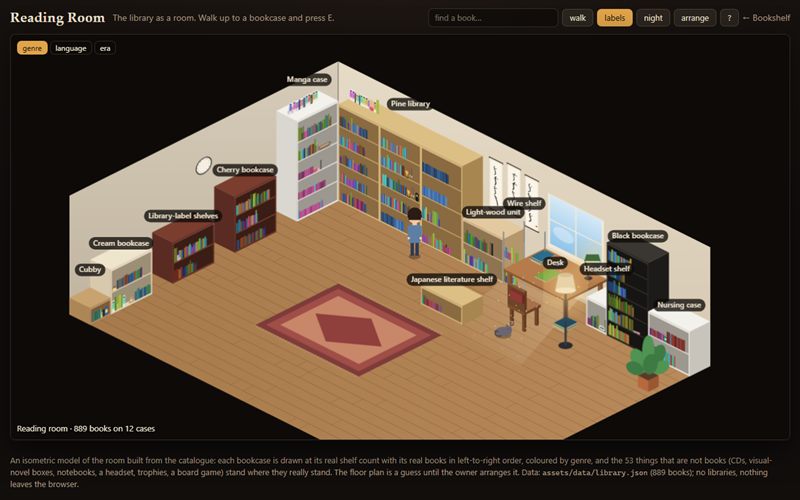
The library as an isometric room: twelve real bookcases, every spine in shelf order, trophies and game boxes where they really sit. Walk up and press E.
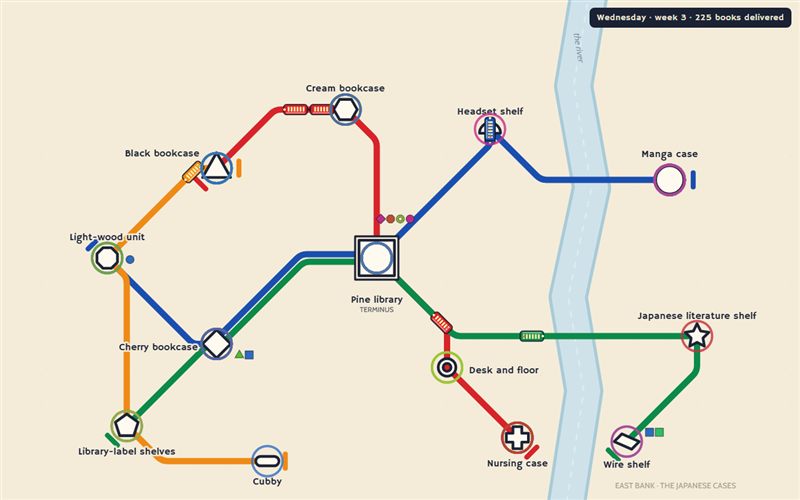
Mini Metro built from one real library: thirteen bookcases are the stations and every passenger is a book trying to get home to its shelf.
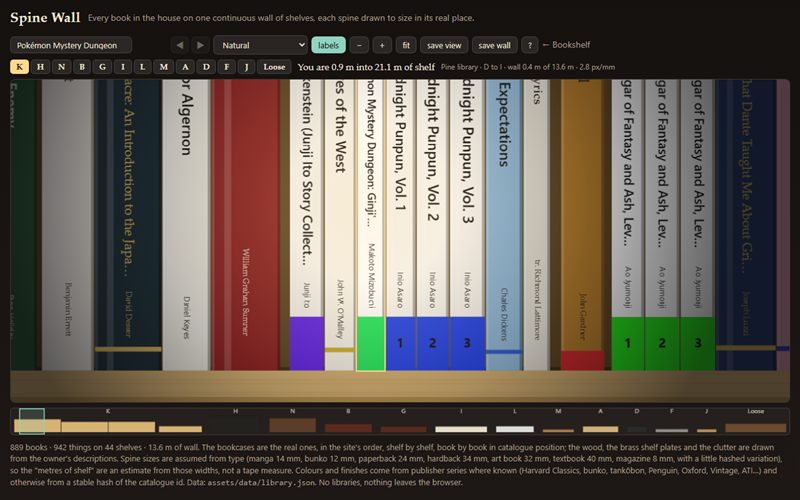
The whole library as one long wall of shelves, every spine drawn to size in its real place. Zoom in to read the titles; search shines a torch on the book.
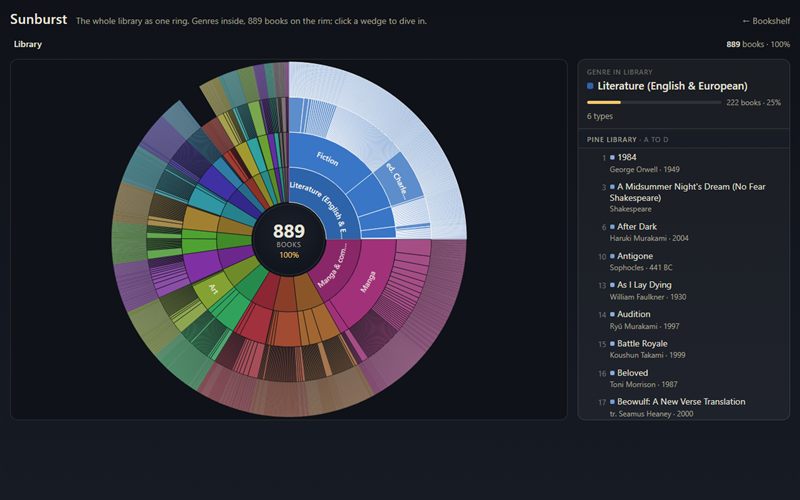
The whole library as one ring: genres inside, 889 books on the rim. Click a wedge to dive in, or fold the same tree into a treemap or an icicle.
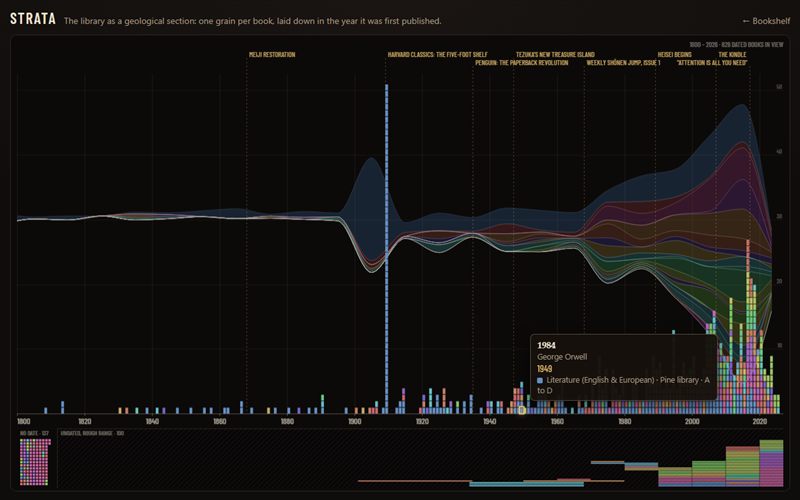
The library cut like a cliff face: every book a grain of sediment in the year it was first published, from Gilgamesh to this year.
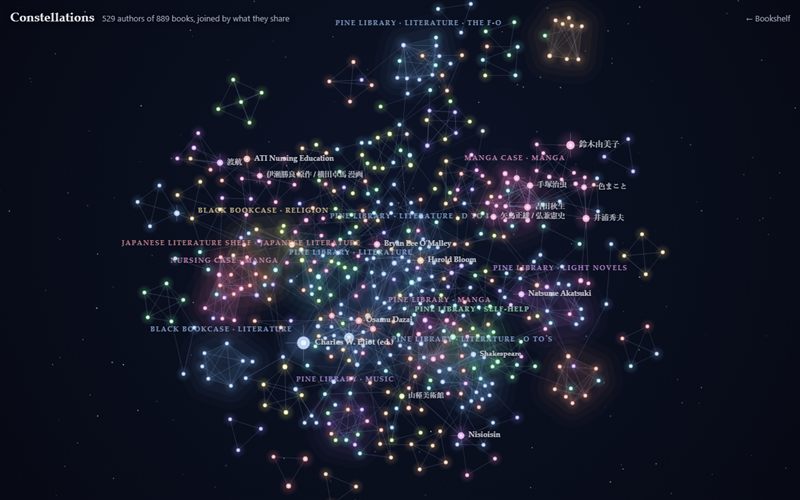
The library's 529 authors as a night sky: stars sized by their books, joined by the shelves, genres, publishers and decades they share.
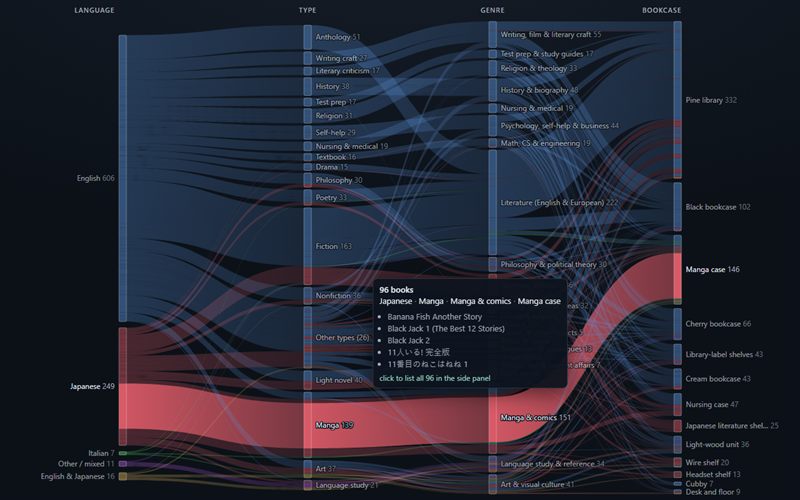
The library as 889 threads braided between facets. Pick language, type, genre, bookcase, era or author as columns and watch the ribbons reshape.
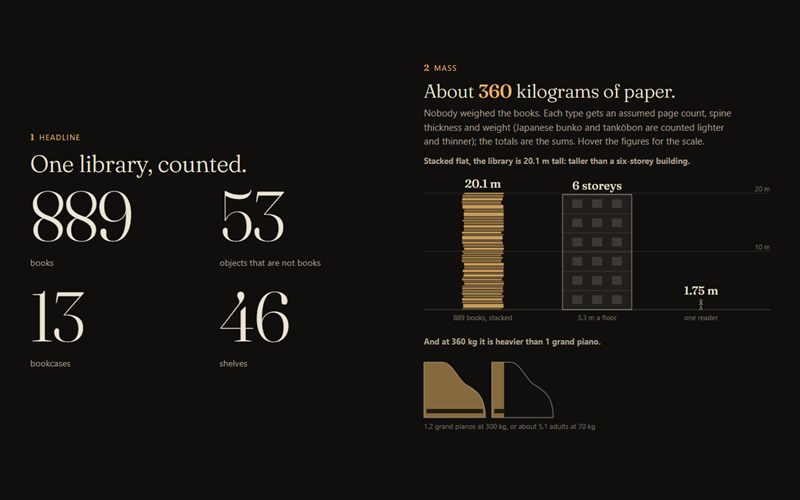
One library weighed, measured and timed: 889 books as 360 kg of paper, a six-storey stack, fifteen years of reading, every count drawn live from the catalogue.
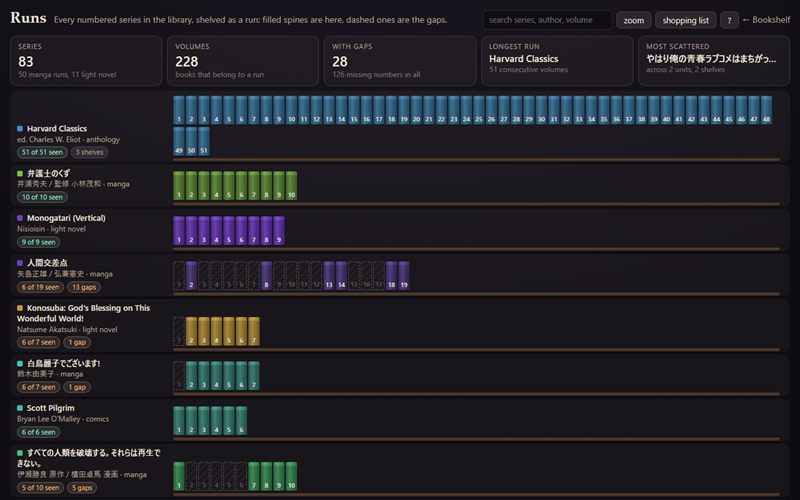
Every numbered series in the library as a shelf of spines: filled ones are here, dashed ones are the gaps, and a shopping list names what is missing.
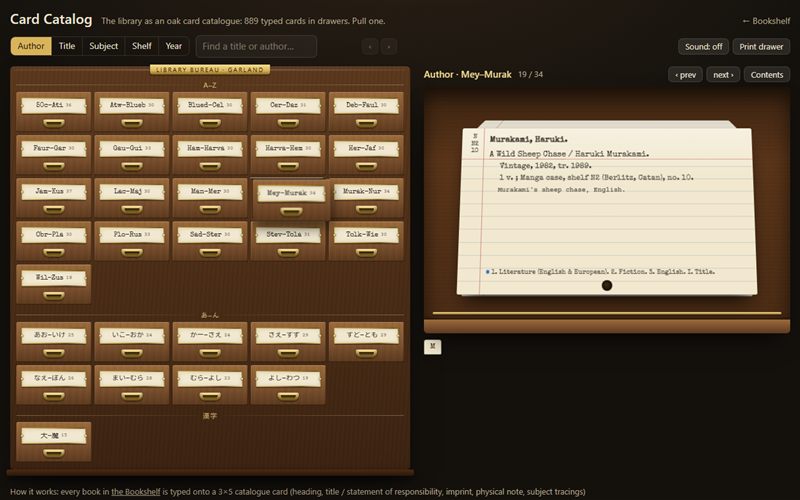
The library as an oak card catalogue: pull a drawer and riffle through 889 typed 3×5 cards filed by author, title, subject, shelf or year.
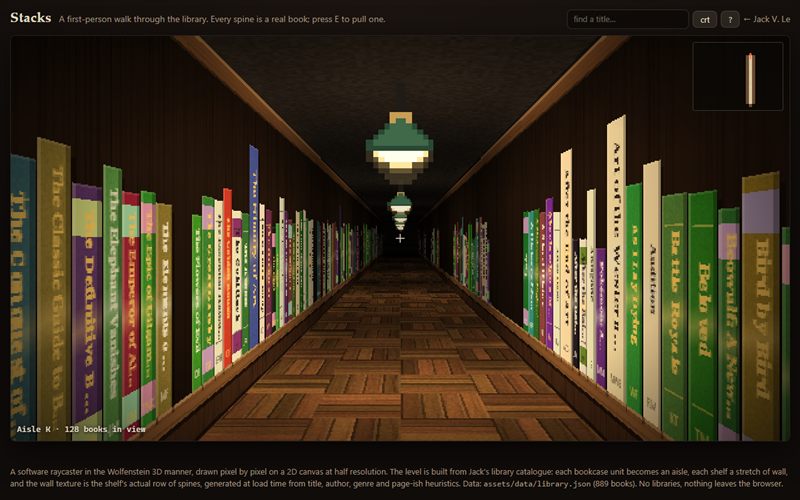
The library as a Wolfenstein-style raycaster: thirteen aisles of real spines drawn from the catalogue. Walk the stacks and pull a book.
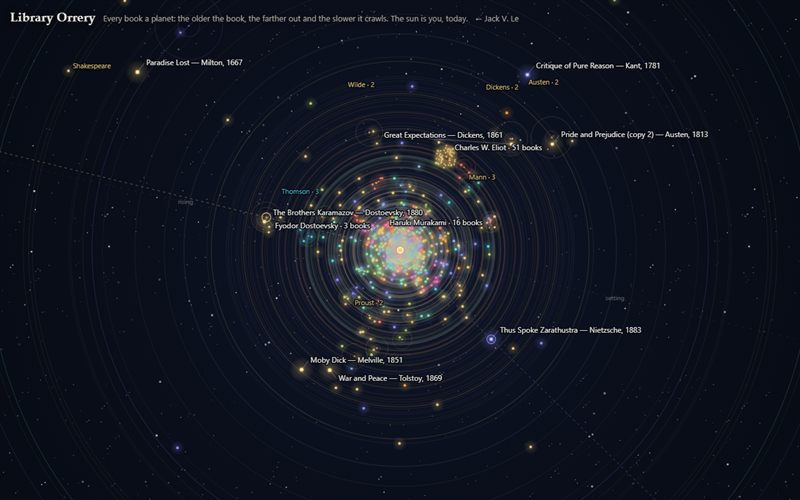
The library as a solar system: every book a planet, the older it is the farther out and the slower it crawls. Scrub ten thousand years for conjunctions.
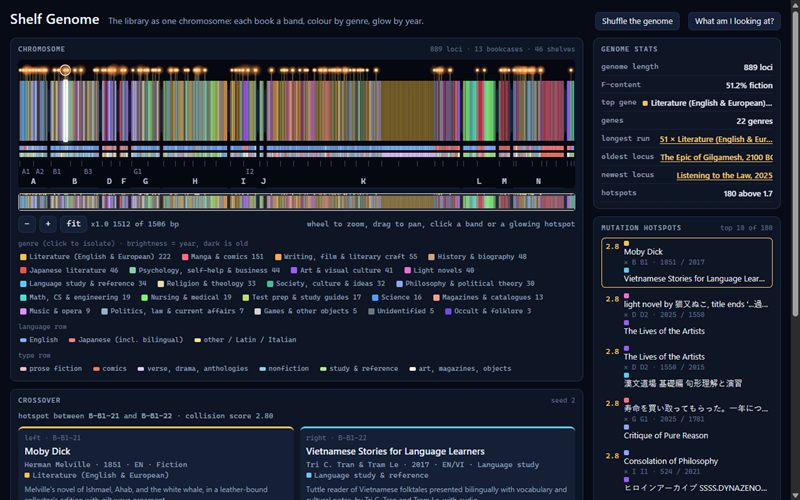
The library as one chromosome: genre bands, year glow, collision hotspots, and fake crossover books.
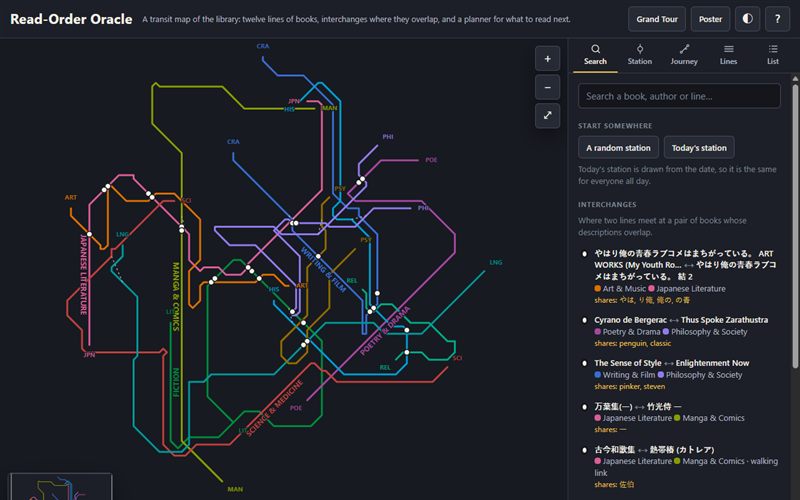
Ride the library: twelve genre lines, interchanges where books overlap, and a journey planner for what to read next.
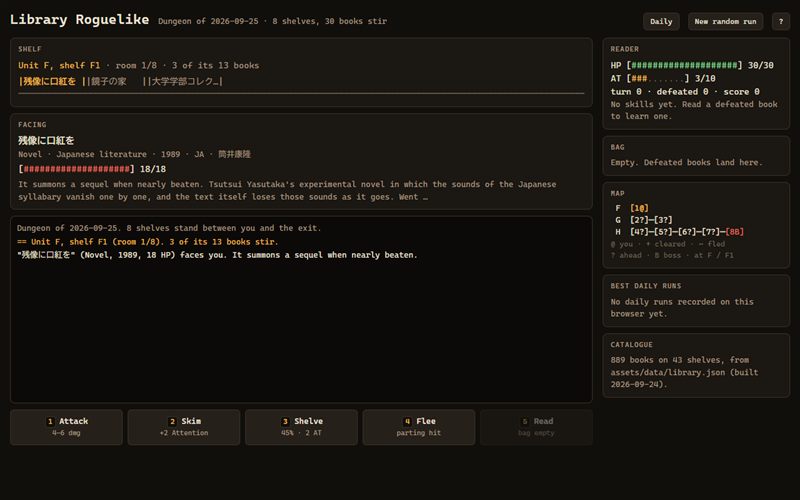
A daily text roguelike where every room is a real shelf of the library and every monster is a book.
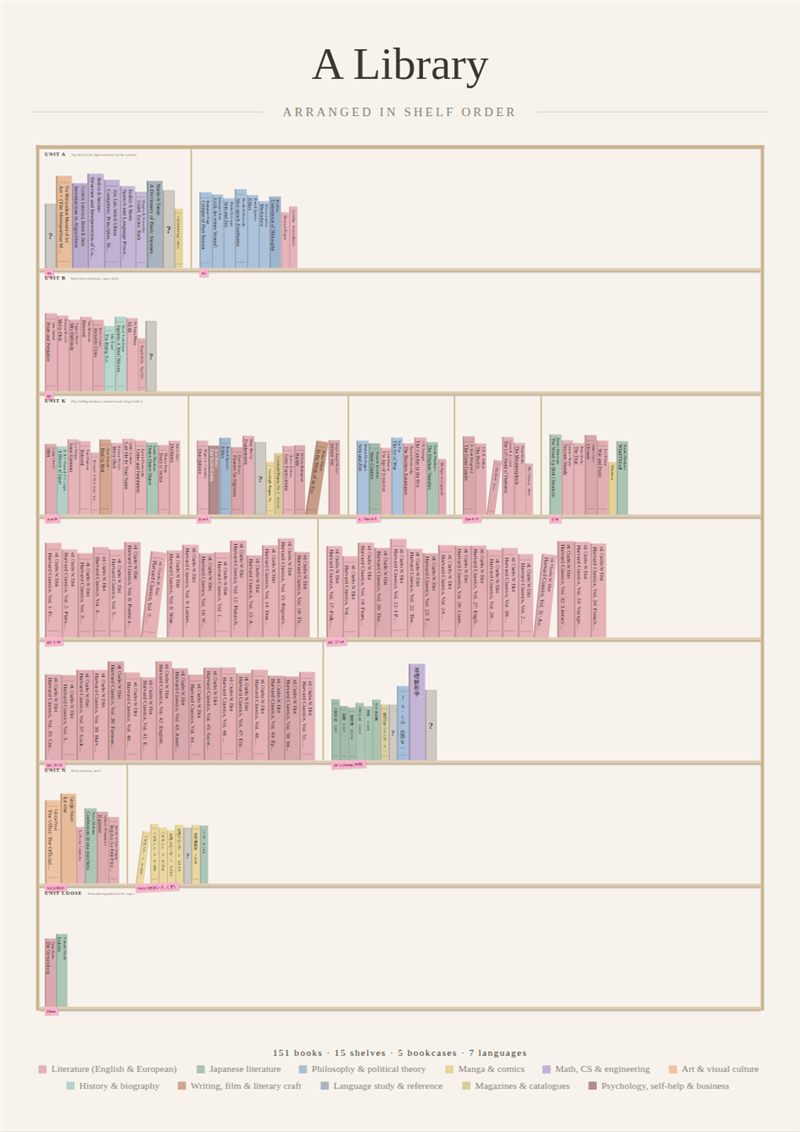
A whole book collection as one printable SVG poster of spines, sized to the paper you pick.
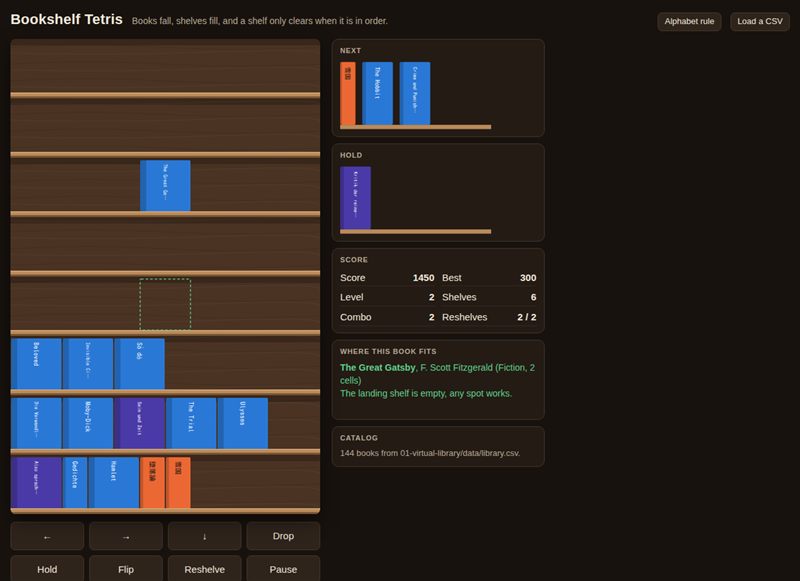
Falling pieces are books. A shelf only clears when its titles read in alphabetical order.
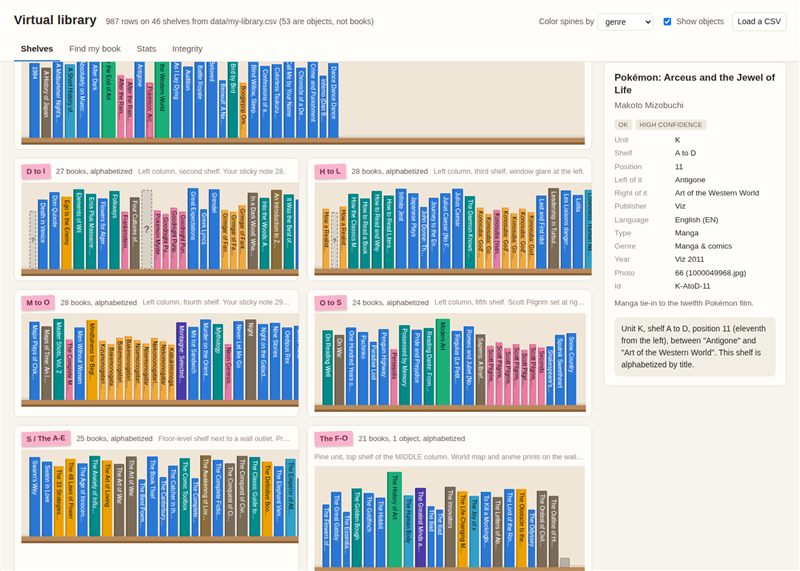
A library catalog as shelves of spines: find a book, browse stats, run integrity checks.
Small things built for fun. Each one is a plain web page with no accounts, no servers and no tracking beyond the site's own. They open in a new tab. Source for the older ones is in NietZteiN/side-projects; the newest live in this site's own repository.
Nothing matches.
Stories and the site 6
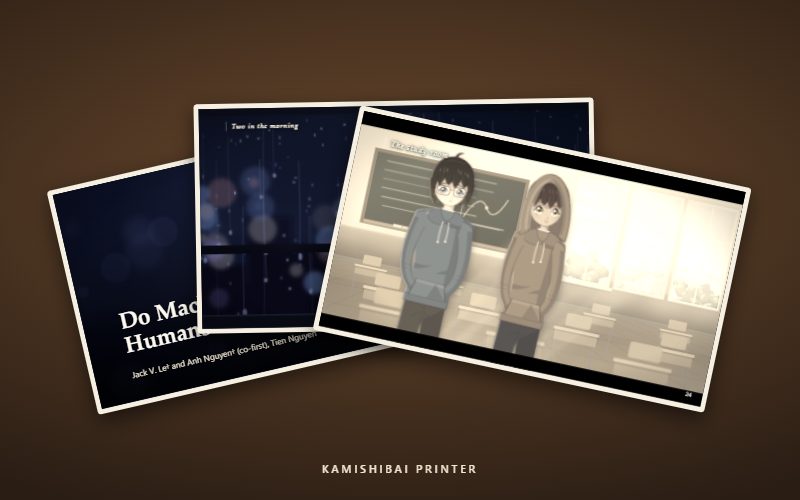
Prints a Paper Theatre story as kamishibai boards: the picture on each front, and on each back the lines for the board in front of it, so it can be read from behind the stack.
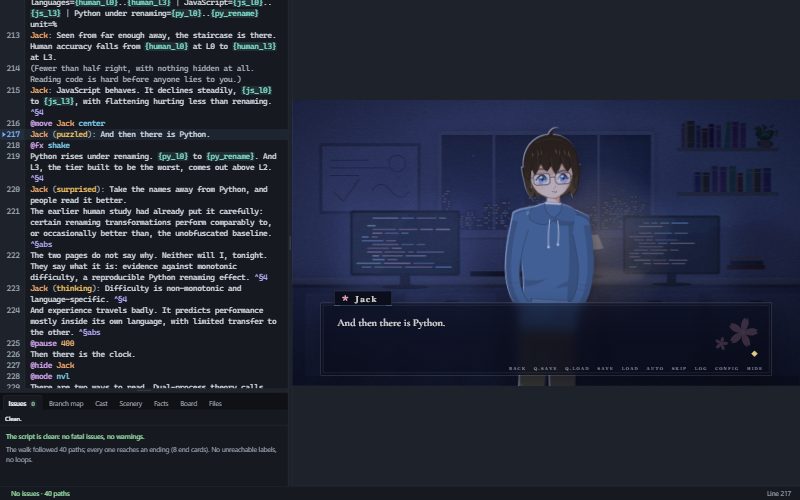
A writing room for Paper Theatre scripts: the .vn text on the left, the live stage on the right, lint and the branch walk on every keystroke. Drafts stay in this browser.
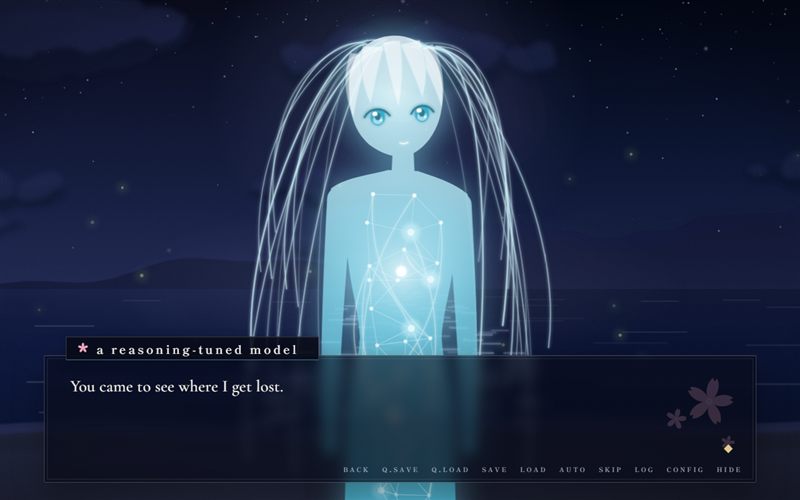
Every paper and post as a two-minute visual novel: a bet, a result, a citation. One engine; each story is a plain-text script you can read in the repo.
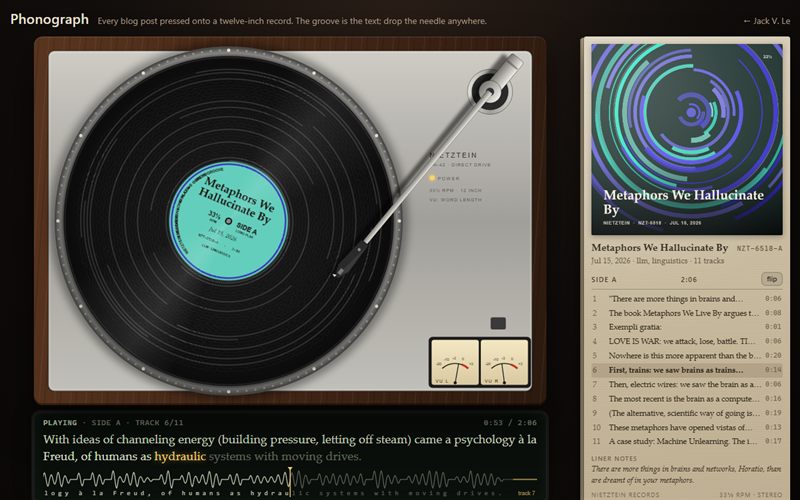
Every blog post pressed onto a twelve-inch record: the groove is the text, paragraphs are tracks, and a tonearm reads it aloud. Drop the needle anywhere.
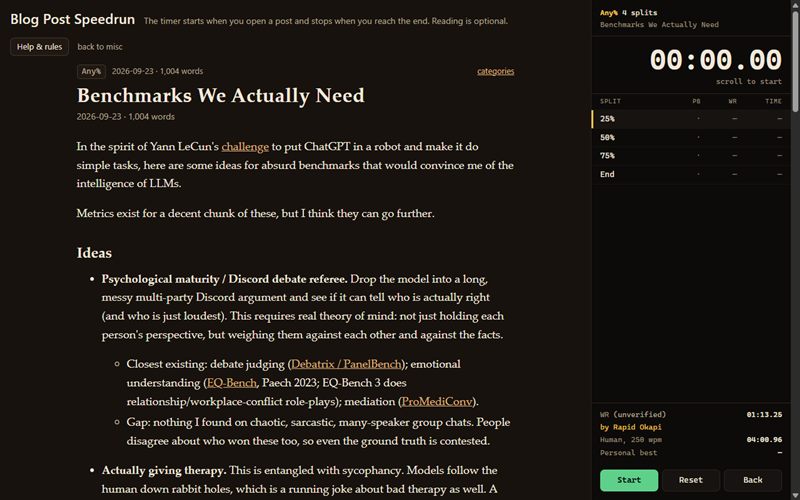
Speedrun the blog: a LiveSplit-style timer, splits, fake unverified world records, a local leaderboard and TAS detection.
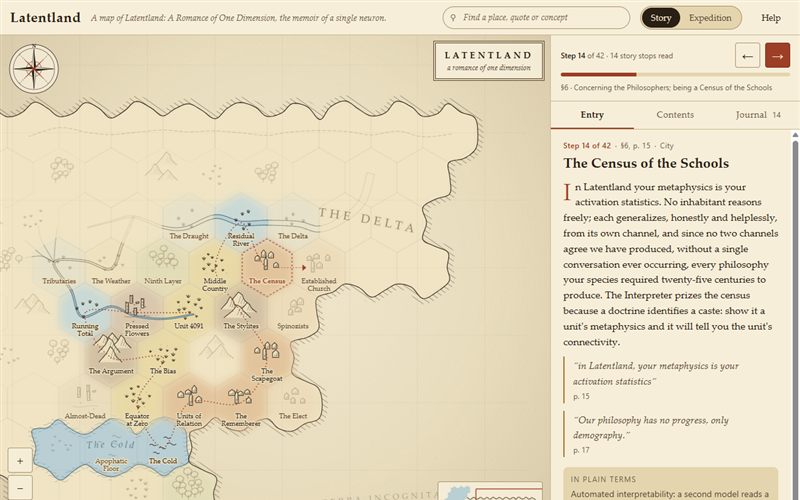
An inked map of Latentland: read the neuron's memoir place by place, or explore it on a budget of surprise.
Machine learning, live 3
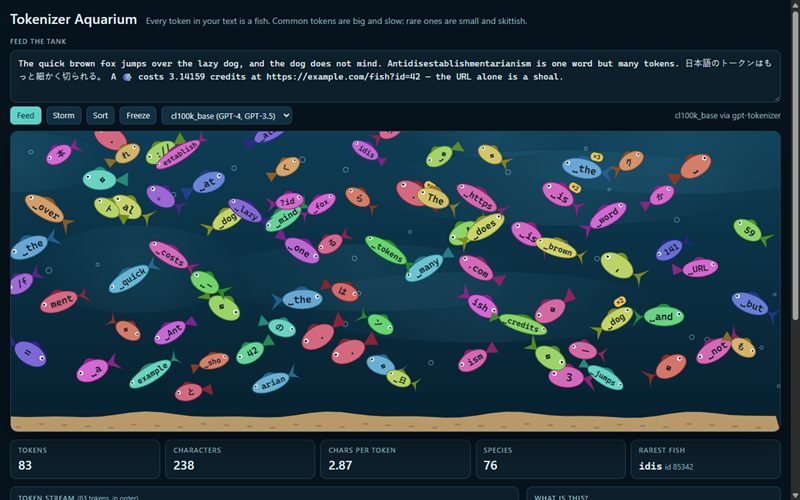
Live BPE tokenisation as a fish tank: common tokens swim big and slow, rare ones small and twitchy.
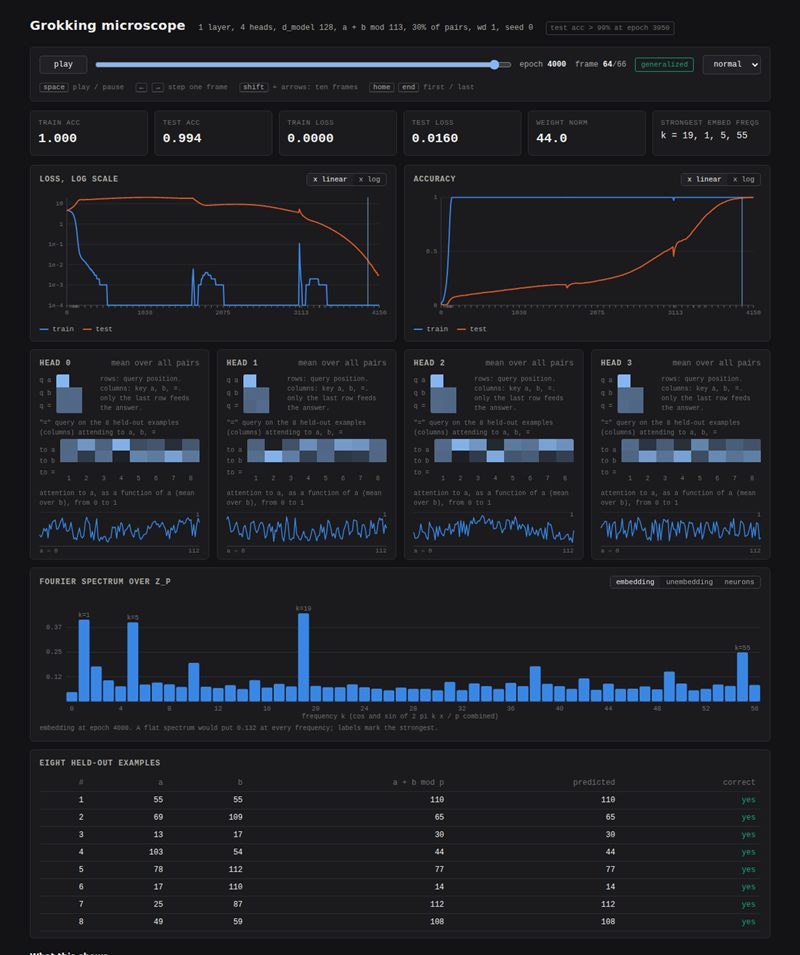
A one-layer transformer learning addition mod 113. Scrub through training and watch it grok.
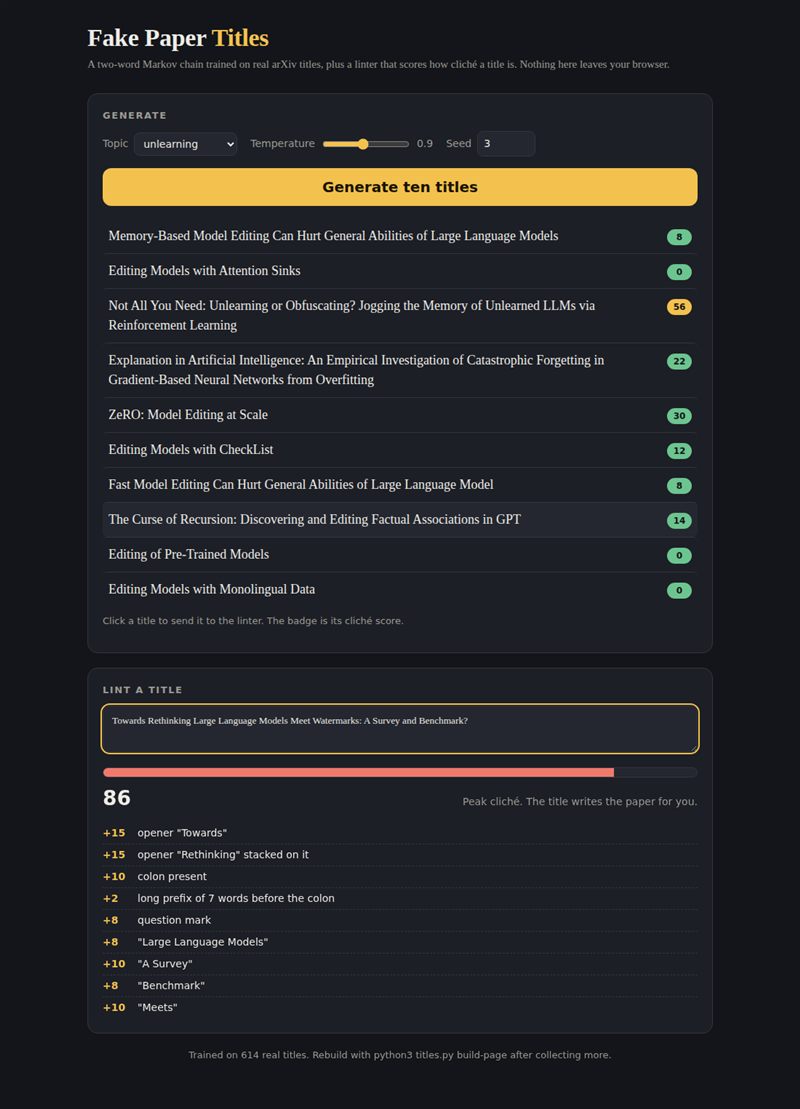
A Markov chain that invents ML paper titles, and a linter that scores how cliché a real one is.
Code and obfuscation 5
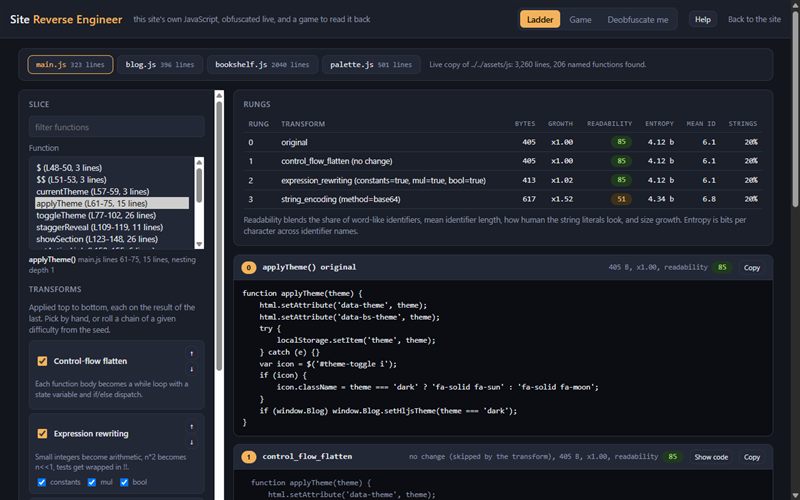
The site's own JavaScript, obfuscated live with the Playground's transforms, plus a daily guessing game.
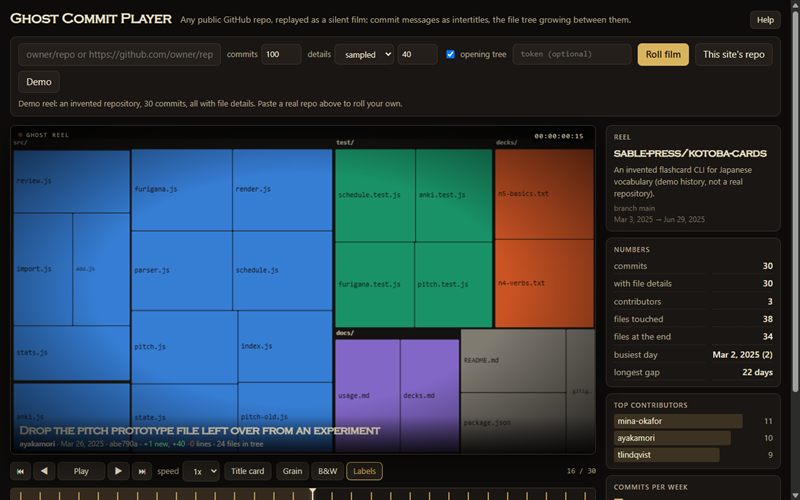
Any public GitHub repo replayed as a silent film: intertitles for commits, the file tree growing between.
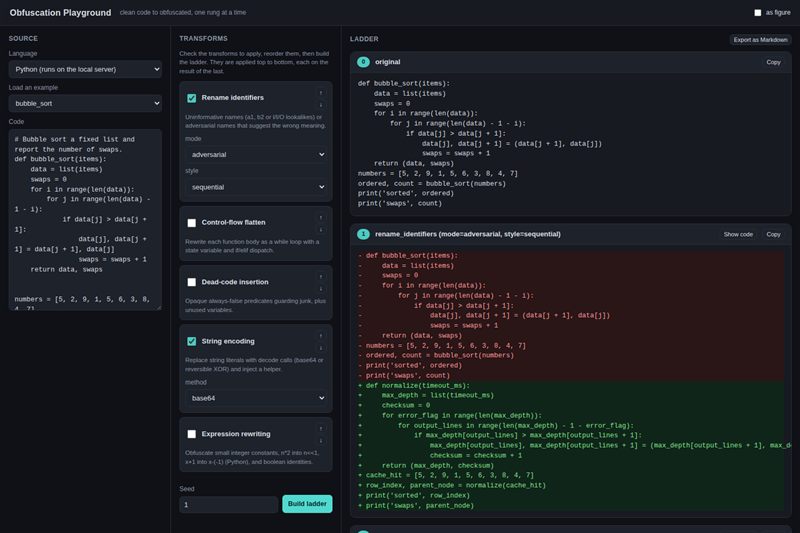
Stack JavaScript obfuscation transforms into a ladder and diff each rung against the last.
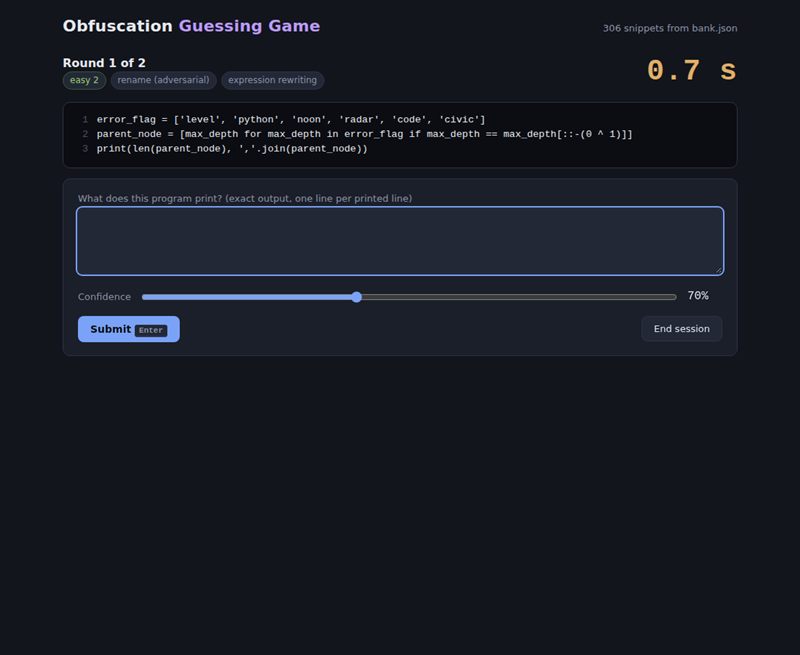
Predict the output of obfuscated Python snippets. Tracks correctness, time and confidence.
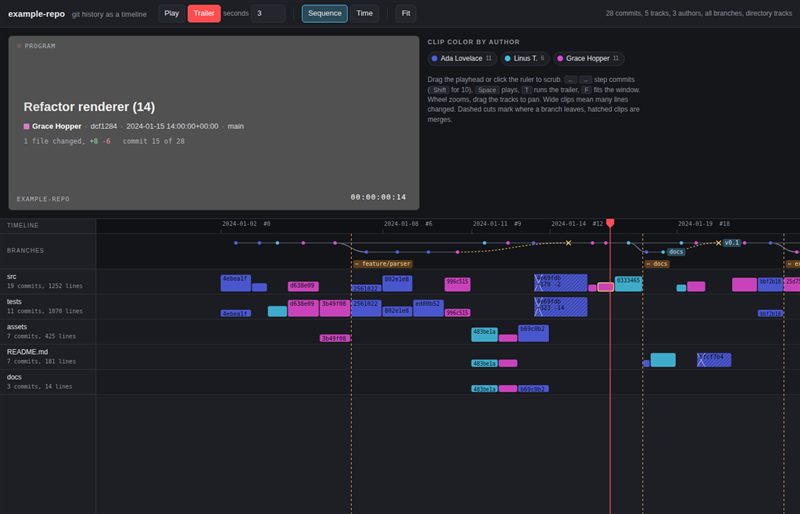
A git history laid out like a video editor, with a trailer that plays the whole thing in 30 seconds.
Shows a bundled example repository.
Language 9
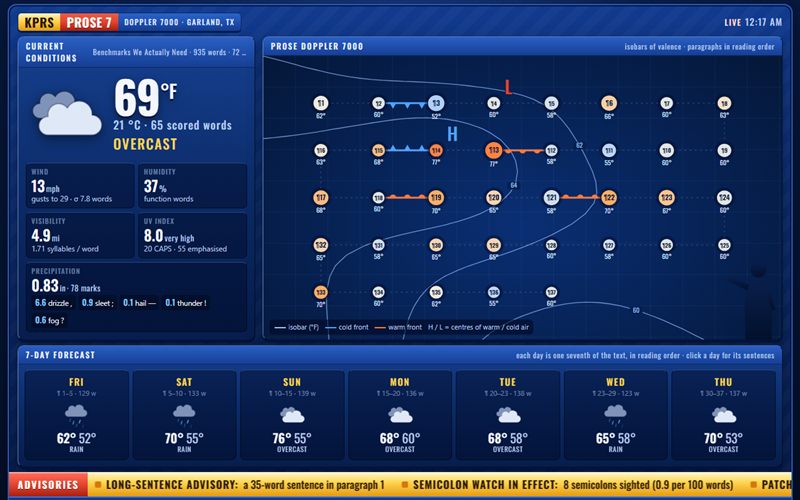
The 10 o'clock forecast for a piece of writing: sentiment is temperature, commas are drizzle, a 45-word sentence is a run-on warning, and every number opens the sentence that caused it.
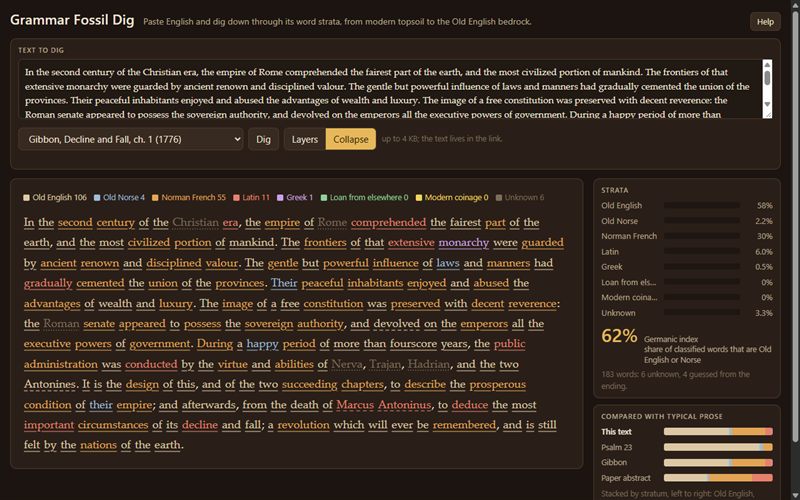
Paste English and dig down through its word strata: modern loans, Latin, Norman French, Norse, Old English bedrock.
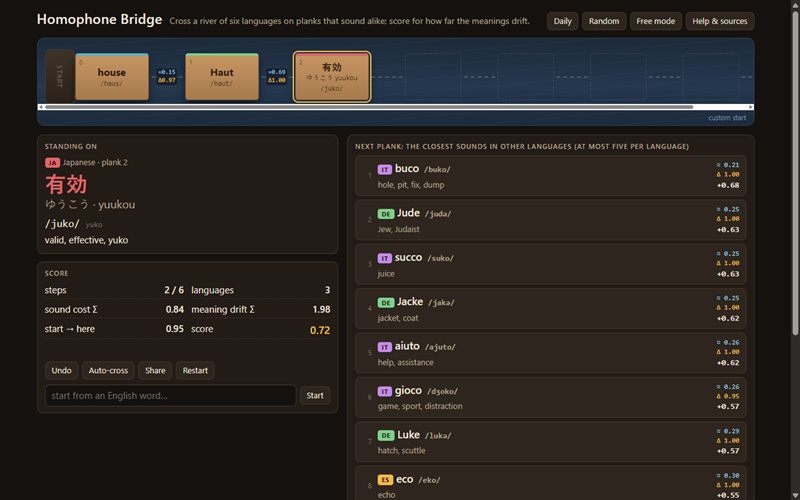
Cross a river of six languages on planks that sound alike; score for how far the meanings drift.
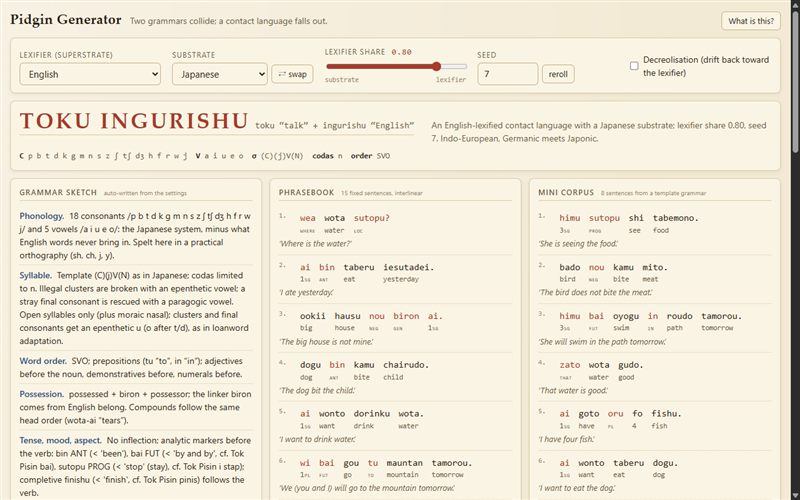
Collide two languages into a toy pidgin: lexicon, phonology, grammar sketch, phrasebook and corpus, all live.
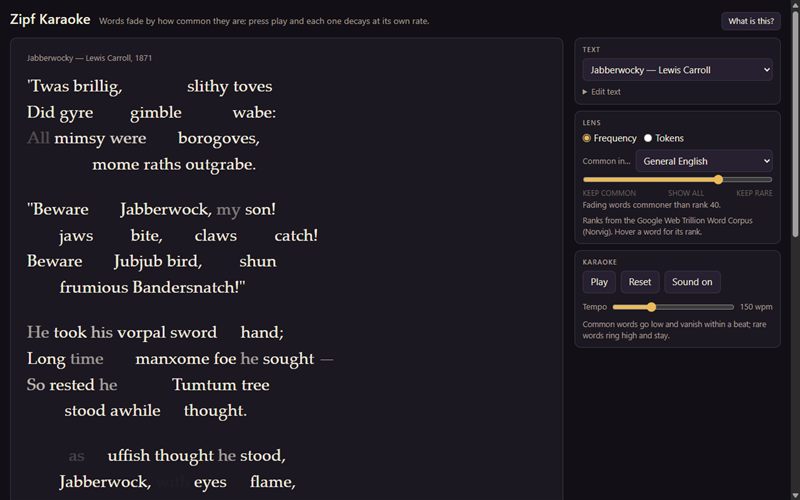
Words fade by how common they are, then get sung: common ones vanish in a beat, rare ones ring and linger.
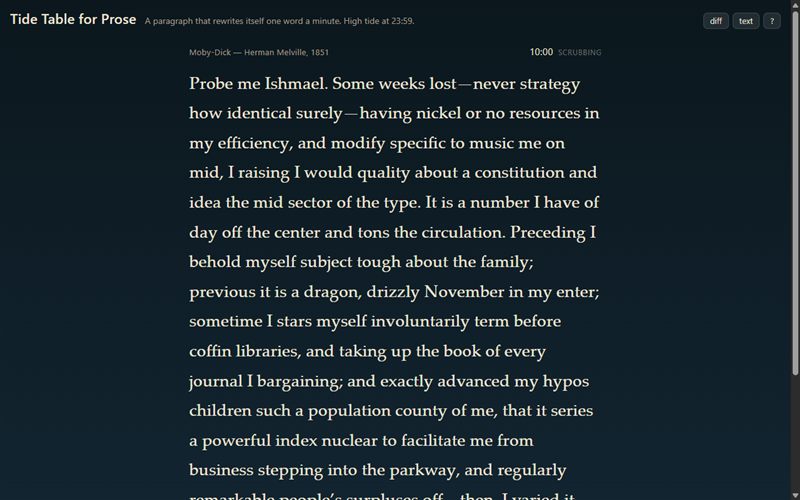
A clock whose face is a paragraph: one word turns into a synonym every minute until midnight.
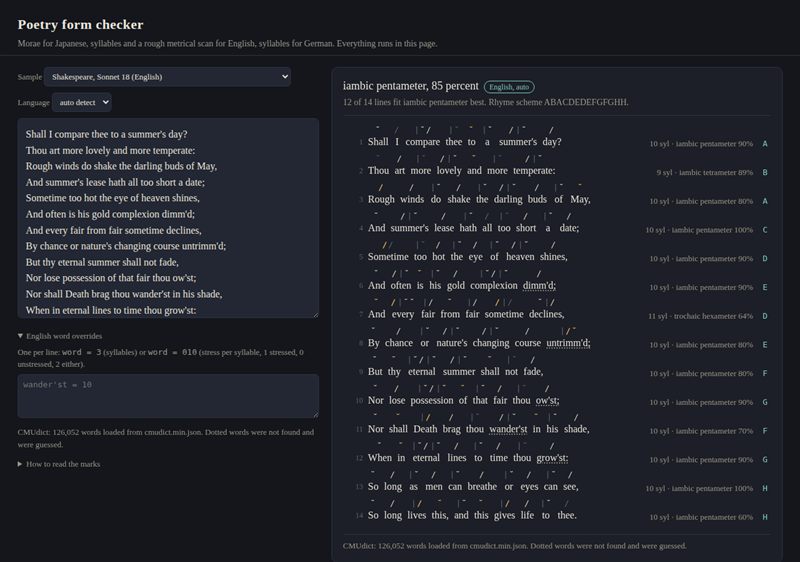
Paste a poem and get morae, syllables, meter and rhyme annotated line by line.
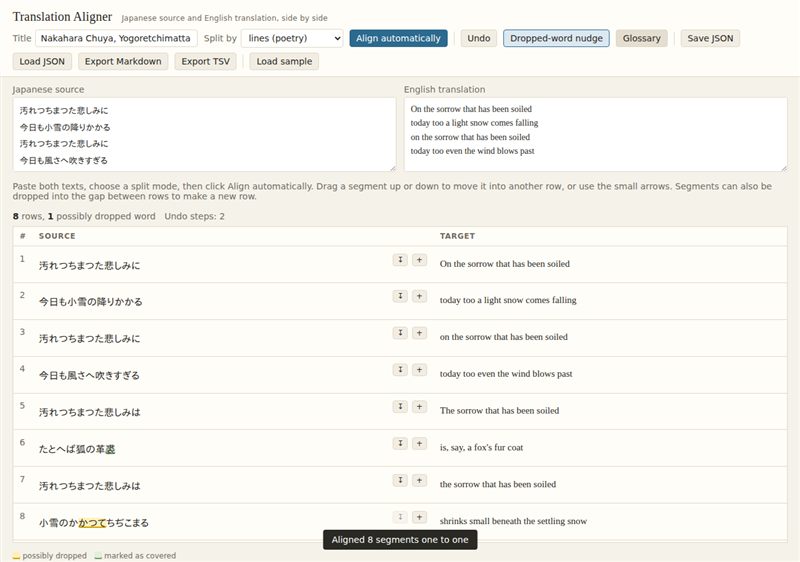
A source text and its translation side by side, sentence by sentence, with manual realignment.
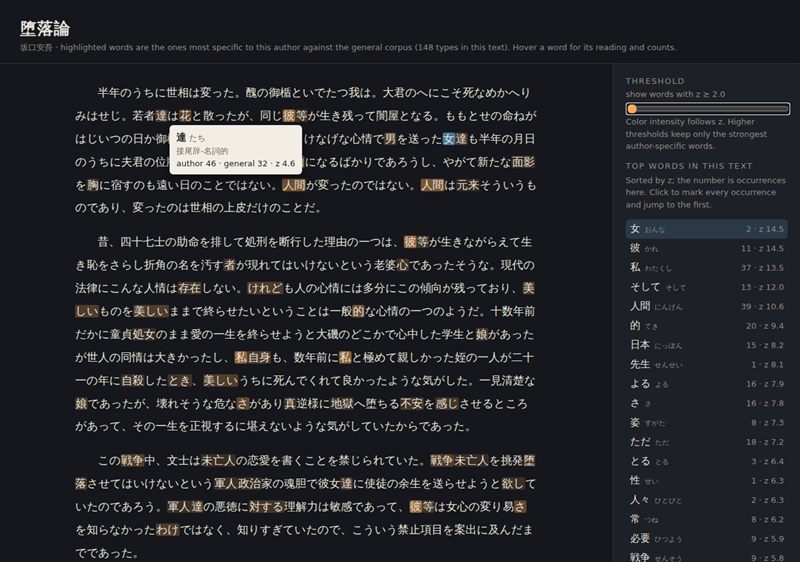
Sakaguchi Ango's 堕落論 with the words he uses unusually often highlighted against general Japanese.
Library 12
The library as a solar system: every book a planet, the older it is the farther out and the slower it crawls. Scrub ten thousand years for conjunctions.
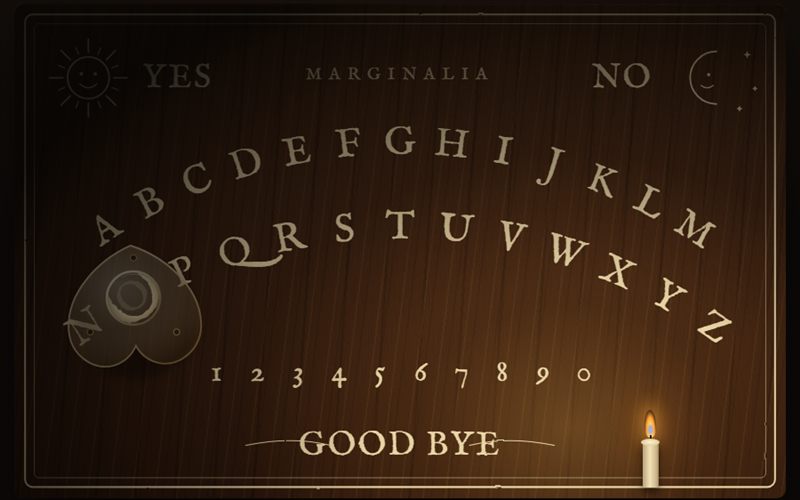
A talking board whose spirits are the authors on these shelves. Ask; the planchette spells an answer stitched from their own book blurbs.
The library as a Wolfenstein-style raycaster: thirteen aisles of real spines drawn from the catalogue. Walk the stacks and pull a book.
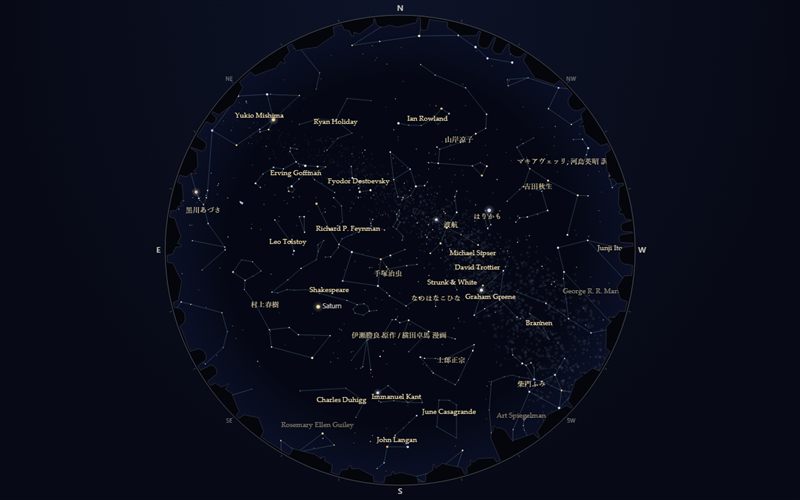
The real Texas sky right now, each of the 88 constellations renamed for a day after an author on the shelf. Click one for its myth.
The library as one chromosome: genre bands, year glow, collision hotspots, and fake crossover books.
Ride the library: twelve genre lines, interchanges where books overlap, and a journey planner for what to read next.
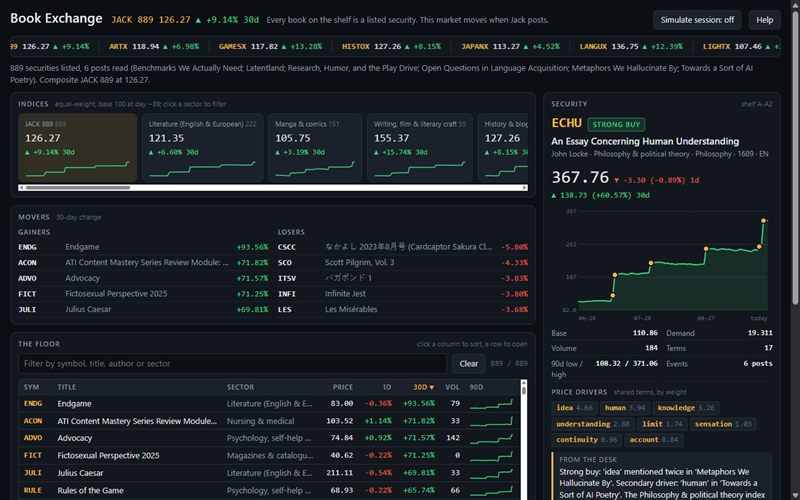
Every library book is a listed stock; prices move when its words show up on the blog. Paper-trade 10,000 credits.
A daily text roguelike where every room is a real shelf of the library and every monster is a book.
Falling pieces are books. A shelf only clears when its titles read in alphabetical order.
A library catalog as shelves of spines: find a book, browse stats, run integrity checks.
Runs on an invented sample catalog.
A whole book collection as one printable SVG poster of spines, sized to the paper you pick.
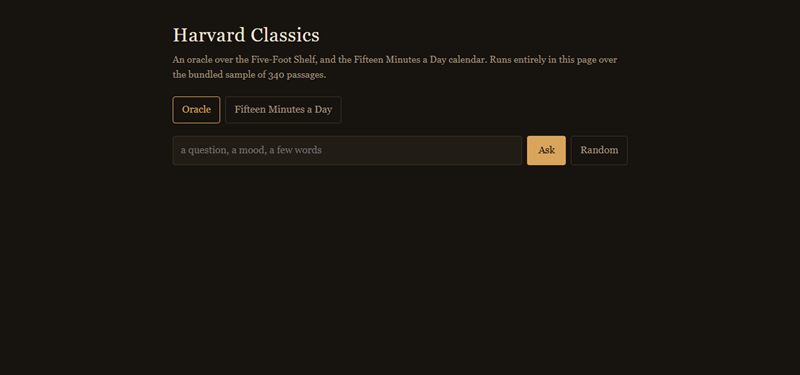
Ask a question or name a mood and get a passage from the Five-Foot Shelf. Also today's Fifteen Minutes a Day reading.
Searches a sample of 340 passages from seven works.
Art and sound 7
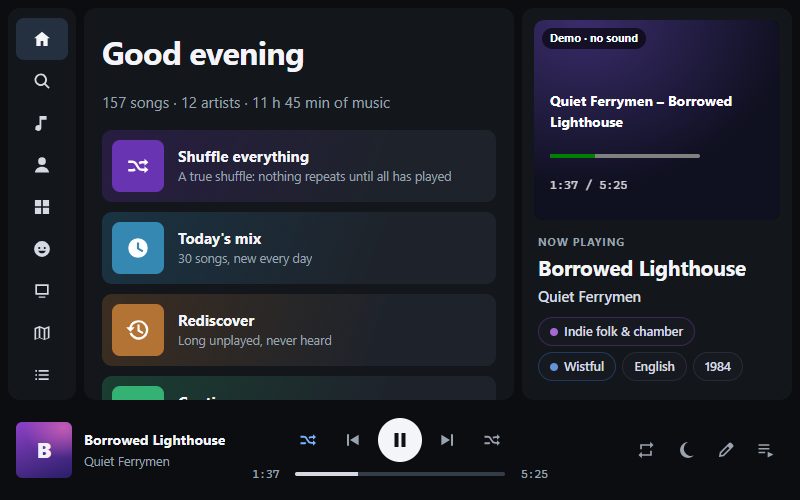
A music app over your YouTube playlists: browse by artist, genre, mood and the anime or game a song is from, then shuffle it properly. A demo runs without signing in.
Signing in works for the owner's Google account; anyone else brings a Google client id of their own.
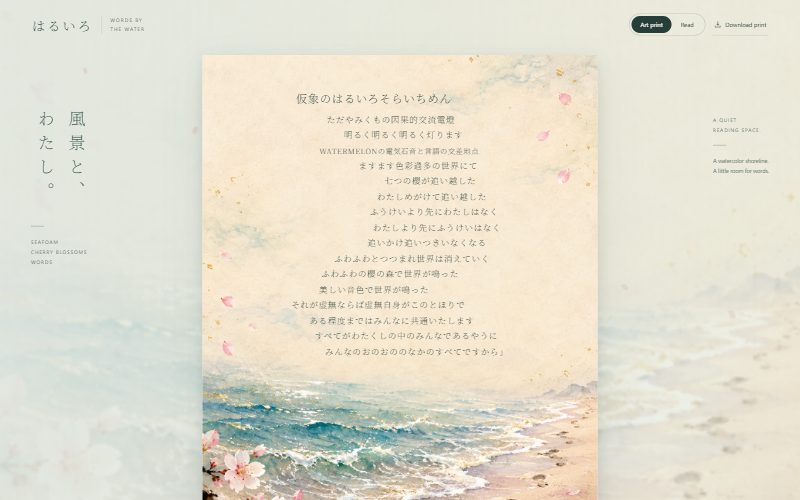 New
A Japanese poem by a watercolor shoreline: switch between the art print and a reading view, or download the A3 print.
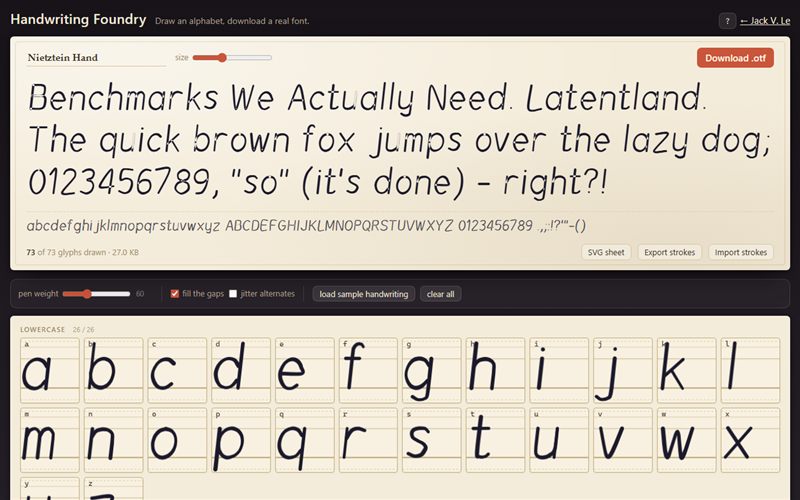
A tiny type foundry. Draw each letter in its cell, watch the page rewrite itself in your hand, and download a real .otf you can install.
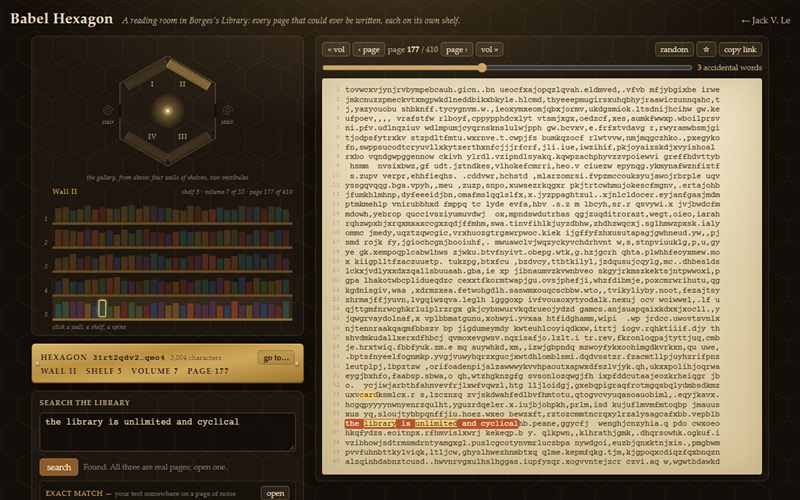
Borges's Library, browsable and complete: every 40-line page that could ever be written sits on a shelf, and whatever you type, the search computes where it already is.
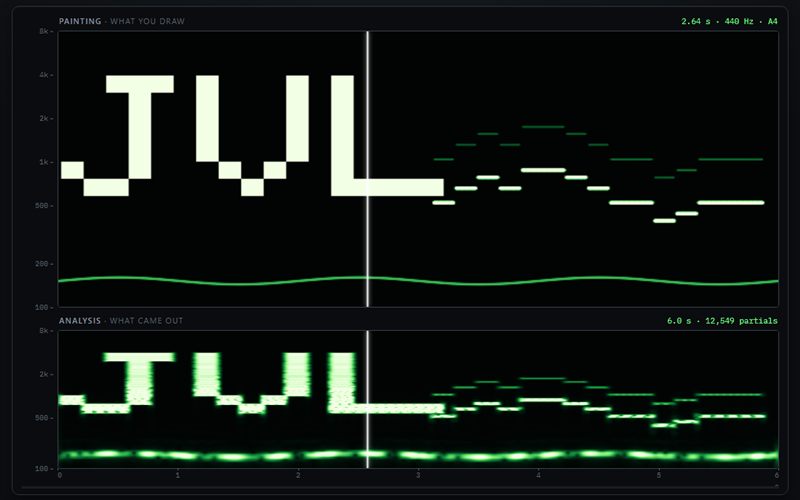
Paint on a spectrogram and hear it: pitch runs up, time runs right, brightness is loudness. Stamp a word and hide it in the sound like Aphex Twin did.
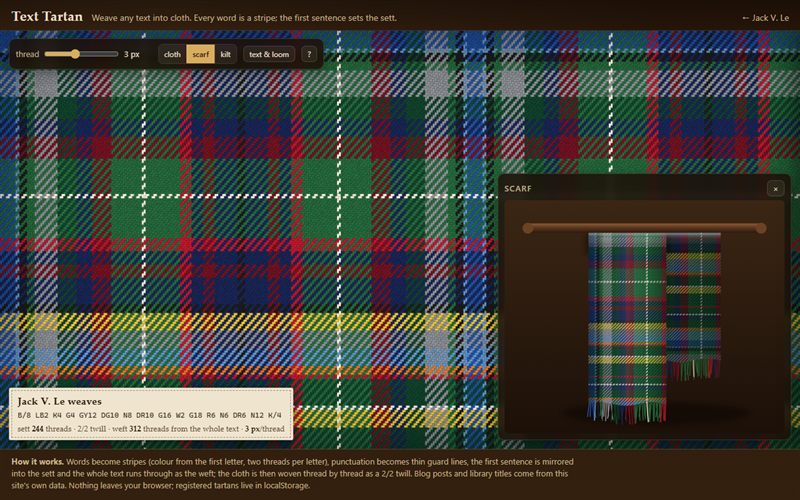
Weave any text into cloth: every word a stripe, the first sentence the sett, the whole text the weft of a 2/2 twill you can zoom into thread by thread.
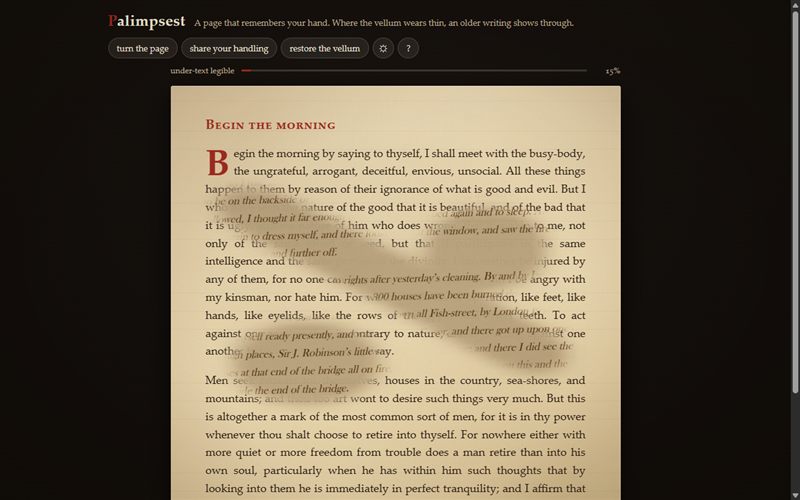
A vellum leaf that remembers your hand: where you rub, an older hidden text shows through, across visits.
Clocks and maps 4
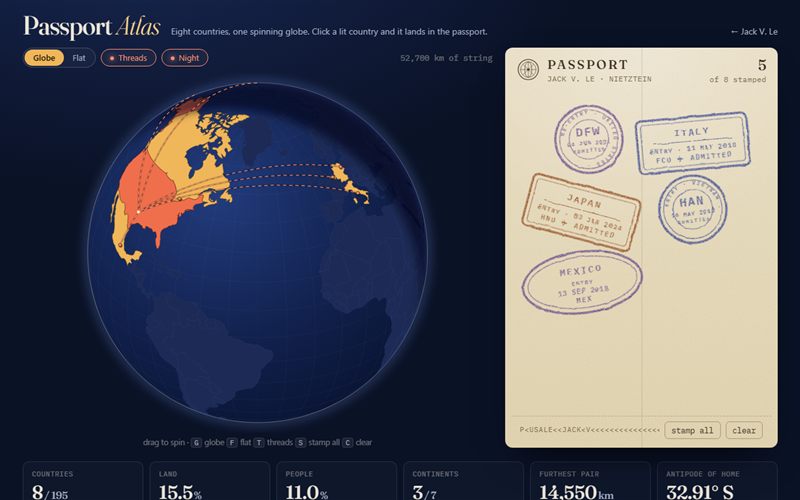
A globe of the eight countries I've set foot in. Spin it, click a lit country, and an ink stamp thumps into the passport beside it.
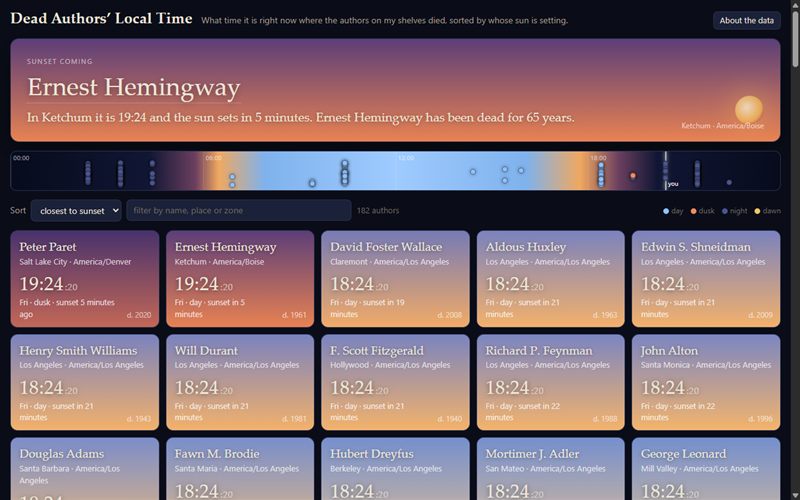
A world clock for the places where the authors on the shelves died, sorted by whose sun is setting right now.
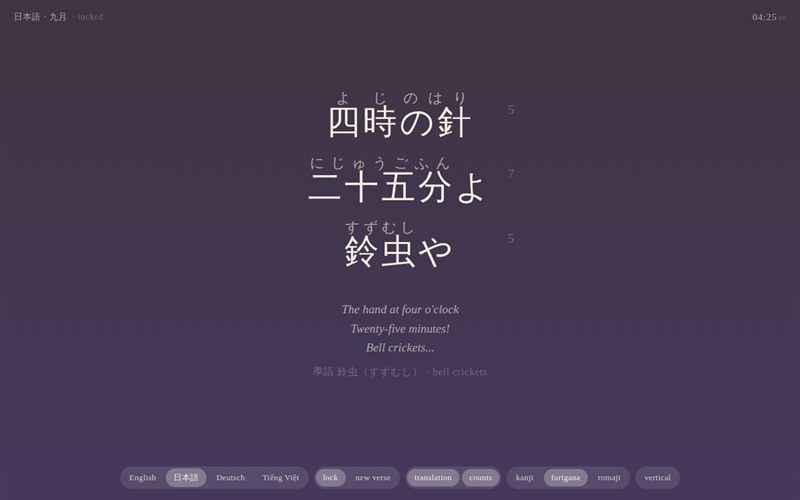
The current time, told as a haiku in four languages.
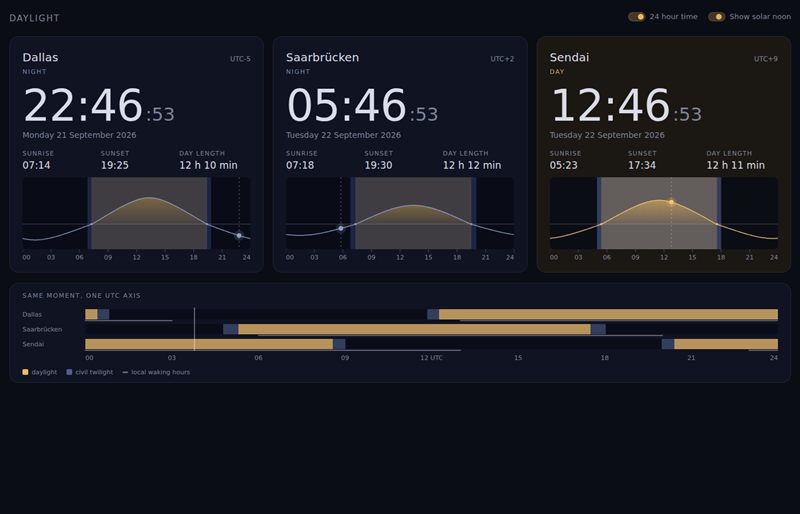
Local time, sunrise, sunset and daylight arcs for three cities at once.